
Emotional Intelligence – the ability to recognise, understand and manage our own emotions, and those of the people around us, in order to nurture positive relationships – is an essential skill for effective leaders, whether you’re leading a team at work, a parent leading your family or a leader in your own life working towards your personal goals.
Everyone is a leader in some way, and everyone can benefit from greater self-awareness, understanding of themselves and others, improved wellbeing and resilience, and learning the softer skills of human nature to build positive relationships both at work and at home.
In the workplace, emotional intelligence defines the non-technical skills we need to be successful in our professional lives – things like knowing how to deal with people, how to come across in the right way, and how to communicate effectively. Thankfully, emotional intelligence skills can be strengthened, learned and developed over time.
“Emotional Intelligence, a different way of being smart, is key to high performance at all levels, particularly for outstanding leadership. It’s not your IQ that matters; it’s how you manage yourself and your relationships.”
Daniel Goleman author of Emotional Intelligence: why it can matter more than IQ.
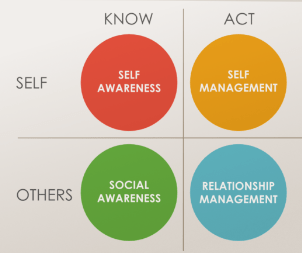
The emotional intelligence (EI) model below was developed by Dr Daniel Goleman and Dr. Richard Boyatzis and comprises four domains and twelve competencies:
- Self-awareness – the ability to recognise and understand our emotions, needs and behaviours and how they impact our interactions with others. Self-awareness forms the foundation of the EI model and competencies include self-awareness and focus.
- Self-management – the ability to manage our own emotions, manage stress, and stay calm and agile in the face of challenges. Competencies include emotional balance, adaptability, achievement orientation and positive outlook.
- Social awareness – the ability to recognise and understand the needs, emotions and behaviours of others to develop a greater awareness of colleagues, family and friends. Competencies include listening, empathy and organisational awareness.
- Relationship management – this domain combines the skills of EI to navigate challenging relationships and nurture positive relationships with the self and others. Competencies include intentional influence, coach and mentor, conflict management, teamwork and inspirational leadership.
Why is emotional intelligence important, especially for leaders?
It is no exaggeration to say that improving our emotional intelligence brings benefits in almost all aspects of our lives and has a positive impact on everyone around us.
- Getting jobs – Nearly 60% of recruiters wouldn’t hire someone with a high IQ score if they didn’t have the emotional intelligence to match it. In fact, emotional intelligence accounts for several of the top 10 most critical skills for the future workforce. 1
- Performance at work – Studies have shown that when comparing people with roughly the same educational backgrounds, emotional intelligence is more important than IQ for workplace performance and 90% of the top performers have high levels of emotional intelligence. What’s more, emotionally intelligent people prove to be more effective leaders and earn a higher than average annual income.2 3
- Future success – In a future powered by artificial intelligence, the global demand for emotional intelligence skills is expected to increase six-fold and become one of the most highly valued and sought-after skillsets. Artificial intelligence, for all its ingenuity, is still not able to mimic human qualities such as emotional intelligence and creative, outside-the-box thinking. Today’s leaders believe emotional intelligence is one of the top three skills that will become even more essential in the future. 4
- Our relationships – Emotionally intelligent people have stronger and more effective relationships with partners and children, family, friends and colleagues.
- How we feel – Emotionally intelligent people experience less anxiety and stress, and tend to be happier, with better physical and emotional well-being, a higher level of resilience and more considered response when dealing with challenges.
If you’d like one-to-one coaching support to develop your emotional intelligence and leadership skills, please click on a button below to get in touch.
 Emma Hackett