
For most of my 20-year corporate career, I was 100% dedicated to my job and it was central to my identity. Then in 2008, I had my first son and took 12 months maternity leave. I struggled with the transition back into the workplace especially as I was now trying to deliver a full-time job in part-time hours. Within a few weeks, my role changed and my workload doubled. I didn’t have the time or resources to deliver the team’s objectives and I felt this was unfair. I challenged the decision, but I had no control over the situation I now found myself in.
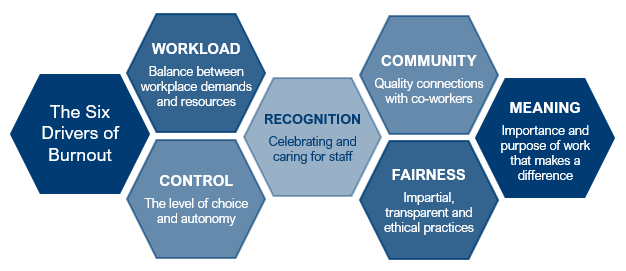
The six drivers of burnout – highlighted in the text
Chronic stress
So, I knuckled down and pushed through to stay on top of the workload. All the while dealing with sleep deprivation and juggling the demands of being a working parent. It felt like the world was moving at speed and I was running just to keep up.
I started to cut corners: I rarely ate breakfast, used caffeine to fuel my morning and grabbed something quick to eat at my desk. I frequently stayed late to do the work I had acquired after a day of back-to-back meetings. I was so exhausted by the time I eventually got home and put our son to bed that I didn’t have the energy to make a healthy dinner. I collapsed on the sofa to binge-watch TV with a bar of chocolate as a reward for getting through another day.
Burnout
After a few months, I felt something shift. Despite being exhausted, I started waking up in the in the early hours dreading the day ahead. When I got to the office, I was overwhelmed by the workload: there was so much to do that I didn’t know where to start, couldn’t make decisions and felt paralysed. I was frustrated and irritable, snapping at colleagues when I was interrupted. And deep down, I couldn’t understand why the job I’d been working in for nearly ten years, a job that I had absolutely loved and knew I was good at, was now so difficult.
One day clearly sticks in my memory: my son was teething and woke up a few times that night. The morning rush to get myself and my son ready and out of the door felt like I’d already done a full day’s work. By the time I arrived at nursery, I sat in the car park and cried. A persistent inner voice told me to “stop making a fuss and get on with it” so I drove to work. I struggled to walk up the hill to the office: my whole body ached, I was out of breath and feeling dizzy. I was uncharacteristically late, but at least I could go up in the lift on my own. I had no desire to make conversation, I just wanted to be invisible. When I finally sat down at my desk, I switched to auto-pilot: the passion and motivation I once had was gone and I felt empty.
I had withdrawn and disengaged. I knew my usually high standards were slipping, my reputation was at risk but I didn’t care. I couldn’t see a way out of this situation, and I began to wonder how long I could keep going…
COLLAPSE
Then in October 2009, my mum died. As my Mum’s next of kin, I had responsibility for organising her funeral, clearing the contents of her house and putting it on the market for sale. This took every ounce of energy I had left and by the end of the weekend we cleared her house, the family home where I grew up and lived for half of my life, I was broken and numb. I returned to work but I could not pretend that I was OK: I felt isolated and lacked support.
One morning the following week, I couldn’t get out of bed. My body had short-circuited: my right leg just wouldn’t move. I went to the doctor and he signed me off work – I just needed some space to breathe. The doctor asked to see me again at the end of two weeks and I naively thought it would take me a few days to ‘sort myself out’ and I would be fine by then. While the time off relieved the pressure, nothing had fundamentally changed so when I saw the doctor at the end of the two weeks, I was no better. He signed me off again for a month.
The three stages of burnout

Depression
Instead of getting better with time off work, I started to decline. My doctor diagnosed me with depression, prescribed anti-depressants and signed me off work for a further six months. While depression is not one of the three stages of burnout, I now understand that the combination of chronic stress, burnout to the point of collapse, plus complex grief in my case made depression likely.
Habitual burnout
After 7.5 months of medical leave, I returned to work. I was scared, ashamed, full of self-doubt and lacking any robust strategies to take care of myself and prevent burnout from happening again. This time, my son was older, we were getting more sleep and there were no significant changes to the job role… so it took me two years to reach the first stage of burnout: chronic stress. This time I knew where this road would lead if I didn’t do something about it, so when maternity leave for my second son came to an end, I chose to resign.
A fresh perspective
As a Leadership Resilience + Performance Coach, I often see chronic stress and burnout in those I am privileged to work with and this led me to train as a Certified Burnout Coach. I have been able to revisit my journey with deeper knowledge, greater understanding and a fresh perspective: each step on my journey towards burnout is now clear. The training showed me that I was not a weak or a failure: burnout was the result of carrying more stress, over an extended period of time, than any human being could manage. At the point of collapse, I had ignored the information from my body for a long time. My mind had pushed me beyond my limits, and I had been running on empty for so long, that both my brain and body shut down to protect me. This was burnout, not depression.
Does this resonate?
If this resonates with you, please know that you are not alone. Many of the high-achieving professionals I work with say that chronic stress, overwhelm, exhaustion or burnout is the price they must pay for success. I wholeheartedly believe it doesn’t have to be this way.
I hope the Six Drivers of Burnout diagram above has widened your perspective to consider all the personal, organisational, cultural and relational factors that contributed to burnout – it is not your fault and there is no need to blame yourself. And I hope the Three Stages of Burnout diagram has shown you that burnout can take years to develop and helped you identify where you are on the burnout continuum.
However you’re feeling about your work and life, and wherever you may be on the burnout continuum, we can turn it around. Work with me to learn how to:

Manage your stress response instead of being ruled by it, learning how to recognise and reduce your stress.

Replenish your energy with good quality sleep, healthy food, gentle movement and relaxation practices.

Quiet the critical, internal monologue that you’re weak, have let everyone down and you’re not a good enough parent, partner, employee or colleague.

Rebuild resilience to overcome challenges and meet the demands of your work and life.

Establish boundaries to take care of yourself and balance your wellbeing with the needs of the business.

Elevate your professional performance, without compromising your wellbeing, for greater impact and business success.

Take proactive, practical steps to recover from burnout and develop robust strategies to prevent relapse.
If you’d like to know more about how coaching can help you, please click the button below to schedule a free, no-obligation clarity call to find out more.
 Emma Hackett